
 PhD student @ Peking University
I am a final-year Ph.D. candidate in the Department of Computer Science at Peking University. I conduct research in the Computer Systems Research Group , co-advised by Prof. Xin Jin and Prof. Xuanzhe Liu. Prior to that, I received my B.S. in Computer Science, also from Peking University.
My research interests lie broadly in designing efficient systems for training and serving deep learning models, with a current focus on large language models (LLMs).
Outside of my academic work, I'm a passionate self-learner with a strong curiosity for various areas across computer science. I created a website called csdiy to share my self-learning experiences and curated resources with the broader community.
Warning
Problem: The current name of your GitHub Pages repository ("Solution: Please consider renaming the repository to "
http://".
However, if the current repository name is intended, you can ignore this message by removing "{% include widgets/debug_repo_name.html %}" in index.html.
Action required
Problem: The current root path of this site is "baseurl ("_config.yml.
Solution: Please set the
baseurl in _config.yml to "Education
-
Peking UniversitySchool of Computer Science
Ph.D. StudentSep. 2022 - present -
Peking UniversityB.S. in Computer ScienceSep. 2018 - Jul. 2022
Experience
-
 DeepSeek RL Infra TeamCore System R&D EngineerApr. 2025 - present
 -
 StepFun System TeamResearch InternJune 2024 - Apr. 2025
 -
 ByteDance SeedResearch InternAug. 2023 - May 2024
 -
 Sky Lab, UC BerkeleyResearch Intern (remote)May 2022 - Feb. 2023
 -
 Alibaba DAMO AcademyResearch InternSep. 2021 - Apr. 2022
 -
AI Innovation Center, Peking UniversitySoftware Engineer InternSep. 2020 - Mar. 2021
Selected Publications (view all )
DeepSeek-V4: Towards Highly Efficient Million-Token Context Intelligence
DeepSeek-AI
Technical Report
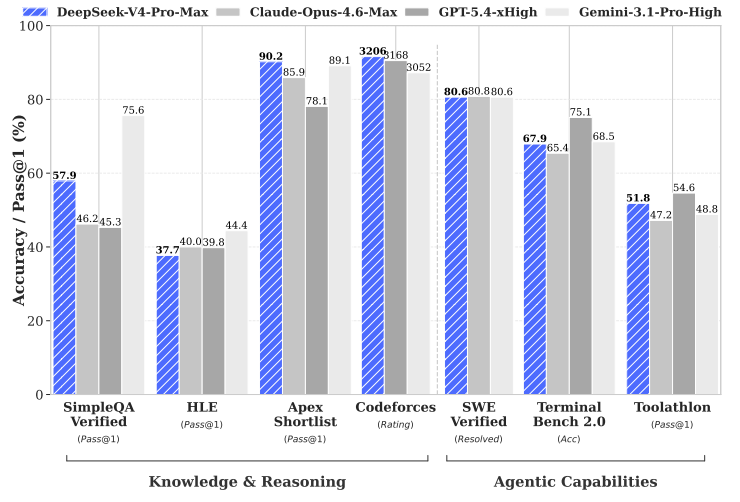
This report presents a preview version of DeepSeek-V4 series, including two strong Mixture-of-Experts (MoE) language models -- DeepSeek-V4-Pro with 1.6T parameters (49B activated) and DeepSeek-V4-Flash with 284B parameters (13B activated) -- both supporting a context length of one million tokens. DeepSeek-V4 series incorporate several key upgrades in architecture and optimization: (1) a hybrid attention architecture that combines Compressed Sparse Attention (CSA) and Heavily Compressed Attention (HCA) to improve long-context efficiency; (2) Manifold-Constrained Hyper-Connections (mHC) that enhance conventional residual connections; (3) and the Muon optimizer for faster convergence and greater training stability. We pre-train both models on more than 32T diverse and high-quality tokens, followed by a comprehensive post-training pipeline that unlocks and further enhances their capabilities. DeepSeek-V4-Pro-Max, the maximum reasoning effort mode of DeepSeek-V4-Pro, redefines the state-of-the-art for open models, outperforming its predecessors in core tasks. Meanwhile, DeepSeek-V4 series are highly efficient in long-context scenarios. In the one-million-token context setting, DeepSeek-V4-Pro requires only 27% of single-token inference FLOPs and 10% of KV cache compared with DeepSeek-V3.2. This enables us to routinely support one-million-token contexts, thereby making long-horizon tasks and further test-time scaling more feasible.
DeepSeek-V4: Towards Highly Efficient Million-Token Context Intelligence
DeepSeek-AI
Technical Report
This report presents a preview version of DeepSeek-V4 series, including two strong Mixture-of-Experts (MoE) language models -- DeepSeek-V4-Pro with 1.6T parameters (49B activated) and DeepSeek-V4-Flash with 284B parameters (13B activated) -- both supporting a context length of one million tokens. DeepSeek-V4 series incorporate several key upgrades in architecture and optimization: (1) a hybrid attention architecture that combines Compressed Sparse Attention (CSA) and Heavily Compressed Attention (HCA) to improve long-context efficiency; (2) Manifold-Constrained Hyper-Connections (mHC) that enhance conventional residual connections; (3) and the Muon optimizer for faster convergence and greater training stability. We pre-train both models on more than 32T diverse and high-quality tokens, followed by a comprehensive post-training pipeline that unlocks and further enhances their capabilities. DeepSeek-V4-Pro-Max, the maximum reasoning effort mode of DeepSeek-V4-Pro, redefines the state-of-the-art for open models, outperforming its predecessors in core tasks. Meanwhile, DeepSeek-V4 series are highly efficient in long-context scenarios. In the one-million-token context setting, DeepSeek-V4-Pro requires only 27% of single-token inference FLOPs and 10% of KV cache compared with DeepSeek-V3.2. This enables us to routinely support one-million-token contexts, thereby making long-horizon tasks and further test-time scaling more feasible.
DeepSeek-V3.2: Pushing the Frontier of Open Large Language Models
DeepSeek-AI
Technical Report
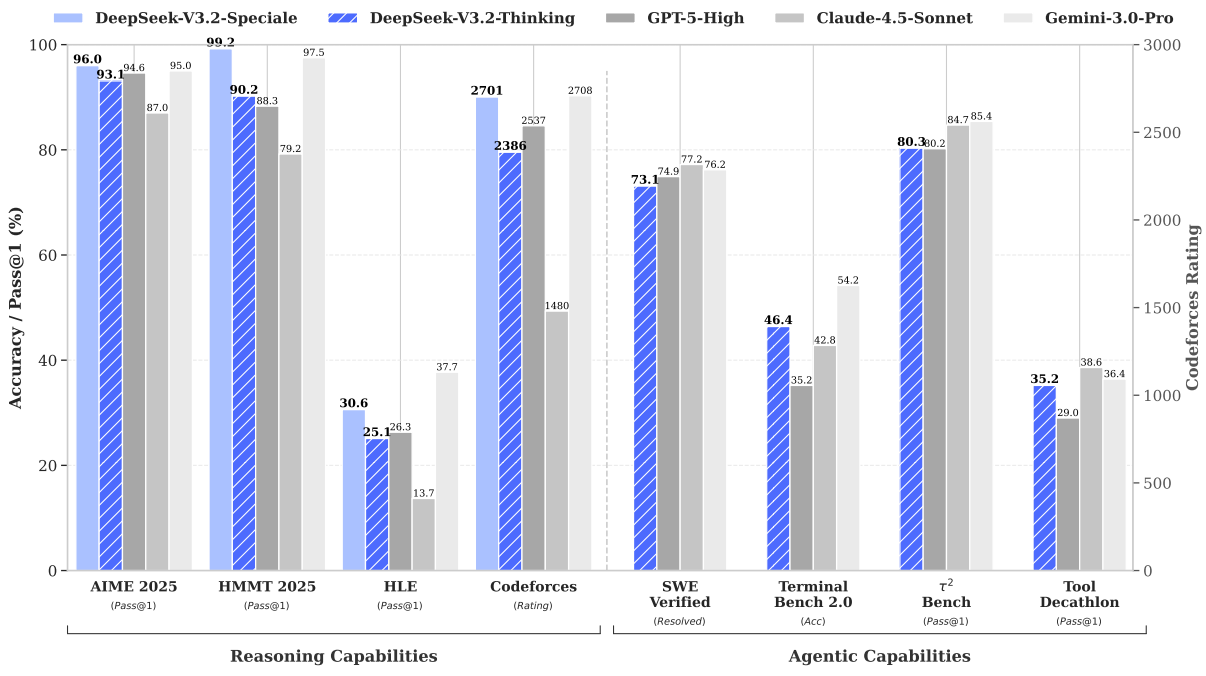
This report introduces DeepSeek-V3.2, a model that harmonizes high computational efficiency with superior reasoning and agent performance. The key technical breakthroughs of DeepSeek-V3.2 are as follows: (1) DeepSeek Sparse Attention (DSA): We introduce DSA, an efficient attention mechanism that substantially reduces computational complexity while preserving model performance in long-context scenarios. (2) Scalable Reinforcement Learning Framework: By implementing a robust reinforcement learning protocol and scaling post-training compute, DeepSeek-V3.2 performs comparably to GPT-5. Notably, our high-compute variant, DeepSeek-V3.2-Speciale, surpasses GPT-5 and exhibits reasoning proficiency on par with Gemini-3.0-Pro, achieving gold-medal performance in both the 2025 International Mathematical Olympiad (IMO) and the International Olympiad in Informatics (IOI). (3) Large-Scale Agentic Task Synthesis Pipeline: To integrate reasoning into tool-use scenarios, we developed a novel synthesis pipeline that systematically generates training data at scale. This methodology facilitates scalable agentic post-training, yielding substantial improvements in generalization and instruction-following robustness within complex, interactive environments.
DeepSeek-V3.2: Pushing the Frontier of Open Large Language Models
DeepSeek-AI
Technical Report
This report introduces DeepSeek-V3.2, a model that harmonizes high computational efficiency with superior reasoning and agent performance. The key technical breakthroughs of DeepSeek-V3.2 are as follows: (1) DeepSeek Sparse Attention (DSA): We introduce DSA, an efficient attention mechanism that substantially reduces computational complexity while preserving model performance in long-context scenarios. (2) Scalable Reinforcement Learning Framework: By implementing a robust reinforcement learning protocol and scaling post-training compute, DeepSeek-V3.2 performs comparably to GPT-5. Notably, our high-compute variant, DeepSeek-V3.2-Speciale, surpasses GPT-5 and exhibits reasoning proficiency on par with Gemini-3.0-Pro, achieving gold-medal performance in both the 2025 International Mathematical Olympiad (IMO) and the International Olympiad in Informatics (IOI). (3) Large-Scale Agentic Task Synthesis Pipeline: To integrate reasoning into tool-use scenarios, we developed a novel synthesis pipeline that systematically generates training data at scale. This methodology facilitates scalable agentic post-training, yielding substantial improvements in generalization and instruction-following robustness within complex, interactive environments.
Optimizing RLHF Training for Large Language Models with Stage Fusion
Yinmin Zhong, Zili Zhang, Bingyang Wu, Shengyu Liu, Yukun Chen, Changyi Wan, Hanpeng Hu, Lei Xia, Ranchen Ming, Yibo Zhu, Xin Jin
Networking Systems Design and Implementation (NSDI) 2025
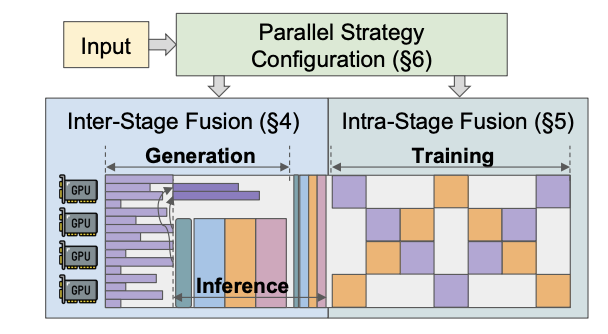
This work presents RLHFuse, an efficient RLHF training system which views the RLHF workflow from a finer-grained subtask-level perspective and opens up opportunities for efficient inter- and intra-stage fused execution, mitigating data skewness and pipeline bubbles in existing systems.
Optimizing RLHF Training for Large Language Models with Stage Fusion
Yinmin Zhong, Zili Zhang, Bingyang Wu, Shengyu Liu, Yukun Chen, Changyi Wan, Hanpeng Hu, Lei Xia, Ranchen Ming, Yibo Zhu, Xin Jin
Networking Systems Design and Implementation (NSDI) 2025
This work presents RLHFuse, an efficient RLHF training system which views the RLHF workflow from a finer-grained subtask-level perspective and opens up opportunities for efficient inter- and intra-stage fused execution, mitigating data skewness and pipeline bubbles in existing systems.

DistServe: Disaggregating Prefill and Decoding for Goodput-optimized Large Language Model Serving
Yinmin Zhong, Shengyu Liu, Junda Chen, Jianbo Hu, Yibo Zhu, Xuanzhe Liu, Xin Jin, Hao Zhang
Operating Systems Design and Implementation (OSDI) 2024
DistServe improves the performance of large language models (LLMs) serving by disaggregating the prefill and decoding computation. Given the application latency requirements, DistServe co-optimizes the resource allocation and parallelism strategy tailored for each phase.
DistServe: Disaggregating Prefill and Decoding for Goodput-optimized Large Language Model Serving
Yinmin Zhong, Shengyu Liu, Junda Chen, Jianbo Hu, Yibo Zhu, Xuanzhe Liu, Xin Jin, Hao Zhang
Operating Systems Design and Implementation (OSDI) 2024
DistServe improves the performance of large language models (LLMs) serving by disaggregating the prefill and decoding computation. Given the application latency requirements, DistServe co-optimizes the resource allocation and parallelism strategy tailored for each phase.
MegaScale: Scaling Large Language Model Training to More Than 10,000 GPUs
Ziheng Jiang*, Haibin Lin*, Yinmin Zhong*, Qi Huang, Yangrui Chen, Zhi Zhang, Yanghua Peng, Xiang Li, Cong Xie, Shibiao Nong, Yulu Jia, Sun He, Hongmin Chen, Zhihao Bai, Qi Hou, Shipeng Yan, Ding Zhou, Yiyao Sheng, Zhuo Jiang, Haohan Xu, Haoran Wei, Zhang Zhang, Pengfei Nie, Leqi Zou, Sida Zhao, Liang Xiang, Zherui Liu, Zhe Li, Xiaoying Jia, Jianxi Ye, Xin Jin, Xin Liu (* equal contribution)
Networking Systems Design and Implementation (NSDI) 2024
This paper presents the design, implementation and engineering experience in building and deploying Megascale, a production system for training large language models (LLMs) at the scale of more than 10,000 GPUs.
MegaScale: Scaling Large Language Model Training to More Than 10,000 GPUs
Ziheng Jiang*, Haibin Lin*, Yinmin Zhong*, Qi Huang, Yangrui Chen, Zhi Zhang, Yanghua Peng, Xiang Li, Cong Xie, Shibiao Nong, Yulu Jia, Sun He, Hongmin Chen, Zhihao Bai, Qi Hou, Shipeng Yan, Ding Zhou, Yiyao Sheng, Zhuo Jiang, Haohan Xu, Haoran Wei, Zhang Zhang, Pengfei Nie, Leqi Zou, Sida Zhao, Liang Xiang, Zherui Liu, Zhe Li, Xiaoying Jia, Jianxi Ye, Xin Jin, Xin Liu (* equal contribution)
Networking Systems Design and Implementation (NSDI) 2024
This paper presents the design, implementation and engineering experience in building and deploying Megascale, a production system for training large language models (LLMs) at the scale of more than 10,000 GPUs.
AlpaServe: Statistical Multiplexing with Model Parallelism for Deep Learning Serving
Zhuohan Li*, Lianmin Zheng*, Yinmin Zhong*, Vincent Liu, Ying Sheng, Xin Jin, Yanping Huang, Zhifeng Chen, Hao Zhang, Joseph E. Gonzalez, Ion Stoica (* equal contribution)
Operating Systems Design and Implementation (OSDI) 2023
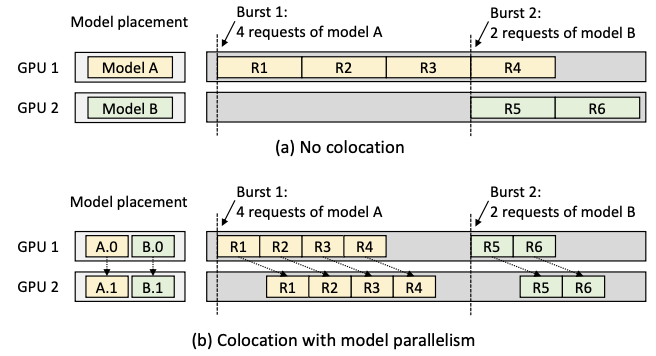
This paper presents AlpaServe, a system for inference servings of multiple large deep-learning models. AlpaServe demonstrates that model parallelism is useful for many other scenarios, quantifies the tradeoffs, and presents techniques to automatically navigate that tradeoff space.
AlpaServe: Statistical Multiplexing with Model Parallelism for Deep Learning Serving
Zhuohan Li*, Lianmin Zheng*, Yinmin Zhong*, Vincent Liu, Ying Sheng, Xin Jin, Yanping Huang, Zhifeng Chen, Hao Zhang, Joseph E. Gonzalez, Ion Stoica (* equal contribution)
Operating Systems Design and Implementation (OSDI) 2023
This paper presents AlpaServe, a system for inference servings of multiple large deep-learning models. AlpaServe demonstrates that model parallelism is useful for many other scenarios, quantifies the tradeoffs, and presents techniques to automatically navigate that tradeoff space.